
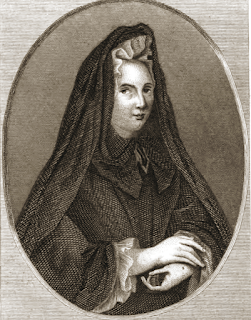
 Reflections on
the Life of
Madame Jeanne de la Mothe Guyon.

Writes to a person of distinction and merit for his advice. Withdraws her request. Result, and remarks upon this incident. Marks of distinction between the wholly and the partially sanctified mind. Lawsuit. Her conduct in connection with it. Remarks.
Another incident, which seems to me to indicate her progress in inward sanctification, may properly be introduced here.
"One day," she says, "laden with sorrow, and not knowing what to do, I wished to have some conversation with an individual of distinction and merit, who often came into our vicinity, and was regarded as a person deeply religious. I wrote him a letter, in which I requested the favor of a personal interview, for the purpose of receiving from him some instruction and advice. But reflecting on the subject, after I had written the letter, it seemed to me that I had done wrong. The Spirit of God seemed to utter itself in my heart, and to say, 'What l dost thou seek for ease? Art thou unwilling to bear the Lord's hand, which is thus imposed upon you? Is it necessary to be so hasty in throwing off the yoke, grievous though it be? '
"In this state of mind, I wrote another letter to the individual whom I have mentioned, in which I withdrew my request, stating to him that my first letter had been written, I had reason to fear, without a suitable regard to God's providence and will, and partly, at least, from the fearful or selfish suggestions of the life of nature; and as he knew what it was to be faithful to God, I hoped he would not disapprove of my acting with this Christian simplicity. I supposed, from the high reputation which he enjoyed as a Christian, that he would have appreciated my motives, and have received this second communication in the Christian spirit in which I hoped it was written.
"But, to my surprise, he did not. On the contrary, he resented it highly. And I think we may well inquire, what explanation shall we give of this sort of Christianity? That this person was religious, in tbe imperfect or mitigated sense of the term, I doubt not. He seems to have been regarded as eminently religious; but it is still true, that his religion, whatever may have been the degree of it, was mixed up, pervaded and animated, more or less, on different occasions, with the life and activities of nature. Certain it is, that the life of nature, or that life which has self and not God for its basis, was not wholly slain within him. He could not say, under all circumstances, 'It is well. Thy will be done.'"
In connection with the conduct of this individual, she makes some profitable remarks. Referring to the important results which characterize the experience of what she appropriately terms inward death, she says, that the soul, which comes out of it in the brightness of the new spiritual resurrection,
"is purified from its selfishness, like gold in the furnace, and finds itself clothed in those dispositions and divine states which shone in the nature and life of Jesus Christ. Formerly, although it had submitted itself to God in the matter of its salvation through Christ, it was still proud of its own wisdom, and inordinately attached to its own will; but now, in the crucifixion of nature and in the life of sanctification, it seeks all its wisdom from God, renders obedience with the simplicity of a little child, and recognizes no will but God's will. Formerly; selfishly jealous of what it considered its rights, it was ready to take fire on many occasions which presented themselves, however unimportant they might be; but now, when it comes in conflict with others, it yields readily and without reluctance. It does not yield, after a great effort and with pain, as if under a process of discipline, but naturally and easily, Formerly, even when it, could justly be said to be religious to some extent, it was puffed up at times with more or less of vanity and self-conceit, but now, it loves a low place, poverty of spirit, meekness, humiliation. Formerly, although it loved others, it loved itself more, and placed itself above them; but now, rejoicing equally in the happiness of others, it possesses a boundless charity for its neighbor, bearing with his faults and weaknesses, and winning him by love. The rage of the wolf, which still remained in some degree, and sometimes showed itself, is changed into the meekness of the lamb."
Such are the accurate terms in which she discriminates between the Christian life in its ordinary appearance of partial sanctification, and the same life when it becomes a "new Christ," by experiencing a more full and complete regeneration into the purity, simplicity, and beauty of the divine image.
About this time, a matter occurred which illustrates her character in other respects. A certain person, whose name is not given, prompted either by malice or by avarice, attempted, by false pretenses, to extort a large sum of money from her husband. The claim, which had the appearance of being one of long standing, was for two hundred thousand livres, which the claimant pretended was due to him from Madame Guyon and her brother conjointly. The claimant was supported in his unjust demand, for what reasons is not known, by the powerful influence of the king's eldest brother, the Duke of Orleans. They tampered with her brother, who was so young and inexperienced as not to understand the merits of the case, in such a manner as to obtain his signature to certain important papers which were to be used in the trial. They had given him to understand, that, if they succeeded in the establishment of their claim, he should not pay anything.
Madam Guyon felt that a great wrong was about to be done. Her husband, perplexed by the apparent intricacy of the affair, or perhaps terrified by the influence of the Duke of Orleans, was unwilling to contend. And it furnished occasion, without any good reason, for new dissatisfaction with his wife, and for new marks of ill treatment. When the day of trial came, after her usual religious duties, in which we may well suppose that she commended this trying business to divine direction, she says that she felt it her duty to take the unusual course of going personally to the judges, and making her representations of the case before them.
"I was wonderfully assisted," she says, "to understand and explain the turns and artifices of this business. The judge whom I first visited, was so surprised to see the affair so different from what he thought it before, that he himself exhorted me to see the other judges, and especially the Intendant, or presiding judge, who was just then going to the Court and was quite misinformed about the matter. God enabled me to manifest the truth in so dear a light, and gave such power to my words, that the Intendant thanked me for having so seasonably come to undeceive, and set him to rights in the affair. He assured me, that, if I had not taken this course, the cause would have been lost. And as they saw the falsehood of every statement, they would not only have refused the plaintiff his claim, but would have condemned him to pay the costs of the suit, if it had not been for the position of the Duke of Orleans, who was so far led astray by the plaintiff as to lend his name and influence to the prosecution. In order to save the honor of the prince, it was decided that we should pay to the plaintiff fifty crowns; so that his claim of two hundred thousand livres was satisfied by the payment of 'one hundred and fifty. Thus moderately and speedily ended an affair, which at one time appeared very weighty and alarming. My husband was exceedingly pleased at what I had done."
We mention this prosecution and the circumstances attending it, not merely as an incident which may properly be regarded as constituting a portion of her life, but as illustrative of character. Independently of the grace of God, which gave to her character its crowning excellence, we have in some incidents of this kind an evidence of what she was by nature; of her clearness of perception, her firmness of purpose, and her eloquence. She had a mind, that was formed by the God who made it to influence other minds. It was only necessary to see her and to hear her, in order to feel her ascendancy; not an ascendancy which was derived from position, but an ascendancy which carried its title in itself; not an ascendancy that was assumed, but an ascendancy given.
— from The Life of Madame Guyon (1877), Volume 1, Chapter 13.
No comments:
Post a Comment