
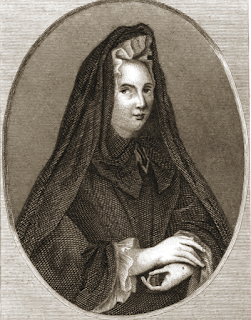
 Reflections on
the Life of
Madame Jeanne de la Mothe Guyon.

Birth of a son. Her religious state at this period, 1673. Death of Genevieve Granger. Their intimacy with each other. Remarks on this addiction. General remarks on worldly attachments and supports.
One of the incidents of the year 1673, to which these series of events now bring us, was the birth of her fourth child, a son, whom Providence had given her in the place of the too much idolized boy, whom she had lost two years before. This son, who seems to have proved himself worthy of her affections, grew up to manhood. But, the grace of God enabled her to love him with that pure and chastened affection which holds every thing in subordination to the divine will.
At the time of the birth, and during the early period of the life of this child, she speaks of herself as being the subject of great inward support and consolation. Her feelings may perhaps be expressed in the language of the Psalmist,— language, which, in various ages of the world, has found a response in many pious bosoms, "Blessed be the Lord, because he hath heard the voice of my supplications. The Lord is my strength. and my shield. My heart trusted in him, and I am helped; therefore my heart greatly rejoices; and with my song will 1 praise him." [Ps. xxviii. 6, 7.]

It increased her affliction, that she was not enabled to be present with her in her last sickness and at the time of her death. She was absent at the time, at a place called St. Reine. Near the close of the life of the Prioress, some one spoke to her in relation to Madame Guyon, with the design, it would seem, of awakening her from a lethargy into which she had fallen. Her mind rallied at a name so dear, and she made the single remark, "I have always loved her in God and for God." These were her last words. She died soon after.
"When I received this news," says Madame Guyon, "I must confess, that it, was one of the most afflicting strokes which I had ever experienced. I could not help the thought, that, if I had been with her at the time of her death, I might have spoken to her, and might have received her last instructions. She had been a great help to me. In some of my afflictions, it is true, I could not see her. Efforts were made to prevent it. This was especially the case for a few months before her death. But still, such was our sympathy of spirit that the remembrance,— the thought of what she might have said or done,— was a support to me. The Lord was merciful, even in this renewed and heavy affliction. He had taught me inwardly, before her death, that my attachment to her, and my dependence on her, were so great, that it would be profitable for me to be deprived of her."
But the necessity of this event, considered in its religious bearings, did not prevent its being keenly painful to nature.
Those who experience the crucifixion of nature, in the full extent of those terms, will find it necessary to die to all human attachments,— not in the absolute sense, it is true, because such attachments are undoubtedly right and well in their place; but it will be necessary to die to them, so far, at least, as they imply a reliance and confidence in the creature, which interferes in the least degree with entire reliance upon God. For wise reasons, therefore, God saw fit, to take from her this prop.
"Oh, adorable conduct of my God!" she exclaims. "There must be no guide, no prop for the person whom thou art leading into the regions of darkness and death. There must be no conductor, no support to the man whom thou art determined to destroy by the entire destruction of the natural life."
Everything upon which the soul rests, out of God, must be smitten, whether reputation, or property, or health, or symmetry of person, or friends, or father, or mother, or wife, or husband, or children.
He, who loses his life, shall find it. Well does she add,
"We are found by being lost; we are saved by being destroyed; we are built up by being first demolished. Man erects his inward temple with much industry and care; and he is obliged to do it with such materials as he has. All this structure and superstructure, whatever it may be and to whatever extent it may be carried, is a new modeling and building up of the old Adam. But all this is removed, and cannot be otherwise than removed and destroyed, when God comes into the soul, and builds a new and divine temple, — a temple not made with hands, and of materials which endure forever. Oh, secrets of the incomprehensible wisdom of God, unknown to any besides himself and to those whom he has especially taught, — yet man, who has just begun his existence, wants to penetrate and set bounds to it! Who is it, that hath known the mind of the Lord, or who hath been his counselor? It is a wisdom only to be known through death to self, which is the same thing as death to every thing that sets itself up in opposition to the true light."
— from The Life of Madame Guyon (1877), Volume 1, Chapter 13.
No comments:
Post a Comment