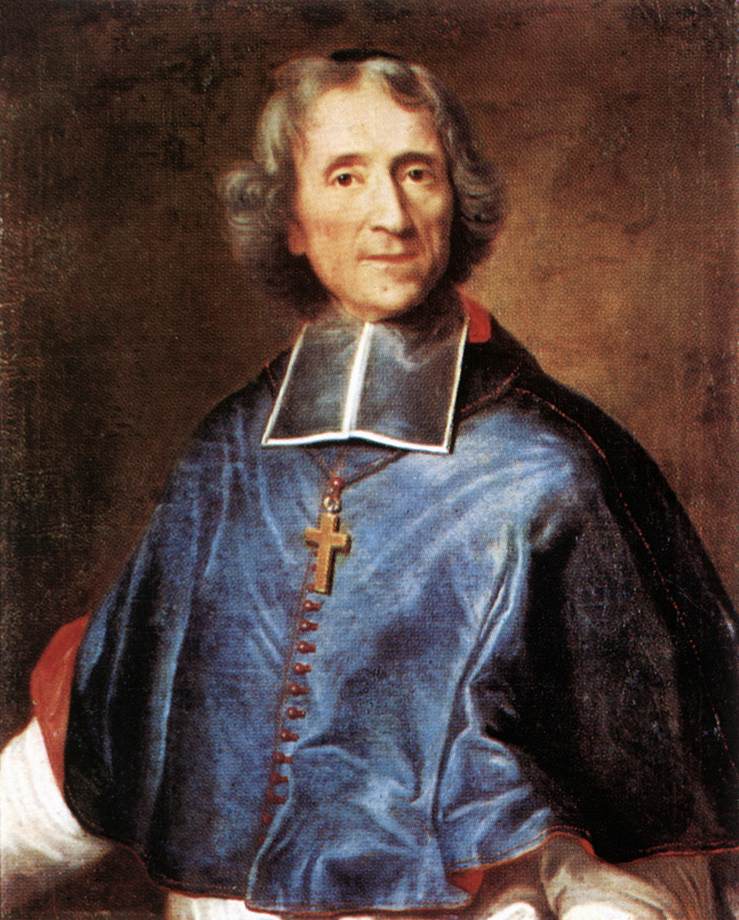
The life of those who dwell in the secret place of the Most High may be called a Hidden Life, because the animating principle, the vital or operative element, is not so much in itself as in another. It is a life grafted into another life. It is the life of the soul, incorporated into the life of Christ; and in such a way, that, while it has a distinct vitality, it has so very much in the sense, in which the branch of a tree may be said to have a distinct vitality from the root.
Showing posts with label death to self. Show all posts

Wednesday, May 7, 2025

The Death of Genevieve Granger


Reflections on
the Life of
Madame Jeanne de la Mothe Guyon.


Birth of a son. Her religious state at this period,  1673.  Death of Genevieve Granger. Their intimacy with each other. Remarks on this addiction. General remarks on worldly attachments and supports.


One of the incidents of the year 1673, to which these series of events now bring us, was the birth of her fourth child, a son, whom Providence had given her in the place of the too much idolized boy, whom she had lost two years before. This son, who seems to have proved himself worthy of her affections, grew up to manhood. But, the grace of God enabled her to love him with that pure and chastened affection which holds every thing in subordination to the divine will. 

Saturday, February 18, 2017

The Inward Burning

Be PATIENT, let the fire consume,
Give God's interior burning room.
Make no resistance, let it blaze.
And self, in root and branch, erase.

The life of self hath long annoyed;
Thy hopes assail'd, thy joys destroy'd;
It poisons every inward sense ;
And FIRE alone can drive it thence.

The fiery trial gives distress;
But never wish its anguish less;
The pain thou feelest is a sign
Of flames from heaven, of fire divine.

Oh let it burn, till pride and lust,
And envy, creeping in the dust,
And wrong and crime, of every name,
Shall perish in the heavenly flame.

— from Christ in the Soul (1872) LXXVII.

Wednesday, July 20, 2016

Dead, Yet Alive Again

It is said that the Christian who has experienced in himself the highest results of religion, is dead, and is alive again. That is to say, he is dead to private aims and private interests; dead to selfish passions, prejudices and pleasures; dead to worldly reputation and honor. But, being dead to himself and whatever concerns himself, he is alive to God; alive to the aims and interests for which Christ came down from heaven, alive to the honor which comes from God, and from God only.

— edited from A Treatise on Divine Union (1851) Part 8, Chapter 8.

Saturday, July 16, 2016

Inward Recollection Inhibits the Self

Another favorable result, connected with the habit of inward recollection, is, that, by confining the mind to the present moment, and retaining God in the position of a present counselor and guide, it prevents the exercise of reflex and selfish acts on the past, and also undue and selfish calculations for the future. Self, if we permit it, will either secretly or openly find nourishment every where; and every where, therefore, we are to fight against it, overcome it, slay it. When the past is gone and we are conscious that we have done  our duty in it, if we would not have the life of self imbibing strength from that source, we must leave it with God in simplicity of spirit; and not suffer it to furnish food either for vanity or disheartening regrets. We should avoid also all undue and selfish calculations for the future, such as continually agitate.and distract the minds of the people of the world; and indeed all thoughts and anticipations of a prospective character, which do not flow out of the facts and the
relations of the present moment, and which are not sanctioned by a present divine inspection.

Happy is the man who retains nothing in his mind, but what is necessary; and who only thinks of each thing just when it is the time to think of it; so that it is rather God, who excites the perception and idea of it, by an impression and discovery of his will which we must perform, than the mind's being at the trouble to forecast and find it. — Fenelon's Directions for a Holy Life.

To these important results, there can be no question, that the habit of inward recollection is exceedingly favorable.

— edited from The Interior or Hidden Life  (2nd Edition, 1844) Part 3, Chapter 7.

Saturday, January 9, 2016

Oh, Sacred Union with the Perfect Mind

Oh, sacred union with the perfect mind!
Transcendent bliss, which Thou alone canst give!
How blest are they, this pearl of price who find,
And, dead to earth, have learnt in Thee to live!

Thus, in thine arms of love, O God, I lie!
Lost, and forever lost, to all but Thee.
My happy soul, since it hath learnt to die,
Hath found new life in thine Infinity.

O, go, and learn this lesson of the cross!
And tread the way which saints and prophets trod;
Who, counting life, and self, and all things loss,
Have found in inward death the life of God.

quoted in A Treatise on Divine Union (1851) Part 7, Chapter 10.


EDITOR'S NOTE: This poem has sometimes been sung as a hymn: for the music, check out hymnal.net here: "Oh, sacred union with the Perfect Mind."


Saturday, November 28, 2015

Unseen But Seen

He  doth not to our sight appear;
And yet the Christ, the King is here.
He is not seen by outward eye,
And yet we feel and know Him nigh.

In holy hearts He builds His throne;
By holy thoughts His presence known;
And most of all He makes His reign,
Where Love is life, where Self is slain.

Oh Life of love, oh Christ within!
A Life, without the stains of sin;
Unknown, unseen by outward sight,
We see Thee in the soul's clear light.

Christ in the Soul (1872) XLII.

Wednesday, August 26, 2015

Objections to the Idea of Inward Crucifixion

When a person has gone through the process of inward crucifixion in its entire length and breadth, the great spiritual result is the complete extinction of all selfishness and of all self-will: a result brought about by means of an entire and unchangeable consecration, attended by the inwardly operating and searching influences of the Holy Spirit; a result, which in the end is so minutely explorative, so thoroughly destructive of those inward influences which obstruct the presence of God in the soul, and withal so painful oftentimes, that it may well be termed the BAPTISM OF FIRE. It is by means of such a process of inward crucifixion, that the natural life dies; and the way is thus prepared for the true resurrection and life of Christ in the soul. 

Friday, August 14, 2015

A Cutting Off

"And if thy right eye offend thee, PLUCK IT OUT,  and cast it from thee; for it is profitable for thee that one of thy members should perish and not that thy whole body should be cast into hell. And if thy right hand offend thee, CUT IT OFF, and cast it from thee; for it is profitable for thee that one of thy members should perish, and not that thy whole body should be cast into hell." — Matt. 5: 29, 30.

The natural life... has a close connection with the natural desires. Just so far as such desires are inordinate in their action, they are the result of unsanctified nature, and not of the Spirit of God. The root, however, the original and fruitful source of that state of things in the natural heart, which is conveniently denominated the Natural Life, is the inordinate action of the principle of SELF-LOVE; denominated, in a single term, selfishness. The pernicious influence from this source, with the exception of what has become sanctified by the Spirit of God, reaches and corrupts every thing. Hence the importance of the process of excision. It is not only important, but indispensably necessary, that this evil influence should be met and destroyed wherever it exists. A process often exceedingly painful; but inevitable to him, who would be relieved from his false position, and put in harmony with God. There must be a CUTTING OFF, and a renewed and repeated CUTTING OFF, till the tree of Self, despoiled of its branches and foliage, and thus deprived of the nourishment of the rain, the sun, and the atmosphere, dies down to its very root; giving place, in its destruction, to the sweet bloom of the tree of life.

A life of practical holiness depends essentially upon two things: FIRST, upon an entire consecration of ourselves, body and spirit, to the Lord; and SECOND, upon a belief that this consecration is accepted. We must, in the first place, offer up our whole being as a sacrifice to the Lord, laying all upon his altar. But we should remember, it is laid there, in order that the natural life may be consumed, and that there may be a resurrection of the true spiritual life from its ashes. He, therefore, who has consecrated himself to God, must expect that the truth of the consecration will be tested by the severity of an interior crucifixion, which is the death of nature, but in the end present and everlasting life. It is not till the flame has come upon us, and we have passed through the fire of the inward crucifixion, which consumes the rottenness and the hay and stubble of the old life of nature, that we can speak, in a higher sense, of the new life; and say, CHRIST LIVETH IN ME.

— edited from The Interior or Hidden Life (1844) Part 2, Chapter 10.

Friday, April 18, 2014

Give All and Take All

The kingdoms of the world are thine,
If  thou hast faith thyself to lose;
But they who seek the ME and MINE,
The universal good refuse.

The master of his own desire,
The victor over selfish claims,
Doth by that DEATH OF SELF aspire
To  universal ends and aims.

He  breaks his bars and prison bound;
And in his free, imperial soul,
Hath boldly reached, and nobly found
The wide, the bright, the kingly whole.

The gems, in hidden mines that glow,
The stars, that shine beyond the skies,
The heavens above, the earth below,
ALL, ALL, are his, to SELF, who dies.

Christ in the Soul (1872) VII.

Tuesday, February 11, 2014

Renunciation of the World or of the Self?

It  may sometimes be practically important  to make a distinction between a renunciation of the world and a renunciation of ourselves. A man may, in a certain sense and to a certain extent, renounce the world, and. yet may find himself greatly disappointed in his anticipations of spiritual improvement and benefit. He has indeed renounced the world as it presents itself to us in its externalities; he has renounced its outward attractions; its perverted and idle shows. He may have carried his renouncement so far as to seclude himself entirely from society, and to spend his days in some solitary desert. But it avails nothing or almost nothing, because there is not at the same time an internal renunciation; a crucifixion and renunciation of self. A mere crucifixion of the outward world may still leave a vitality and luxuriance of the selfish principle; but a crucifixion of self necessarily involves the crucifixion, in the Scripture sense, of everything else.

Religious Maxims (1846) XXII.

Saturday, February 8, 2014

Death to Self

Look not for a, true living strength,
In the life of the ME and the I,
With nothing to love but its self-hood,
And fearing to suffer and die.
As thou seekest the fruit
From the seed-planted grain,
Seek life that is living,
From life that is slain.

Then hasten to give it its death-blow,
By nailing the I to the Cross;
And thou shalt find infinite treasure,
In what seemeth nothing but loss;
For where, if the seed
Is not laid in the ground,
Shall the germ of the new
Resurrection be found.

The soul is the Lord's little garden,
The I is the seed that is there;
And He watches it, While it is dying,
And hath joy in the fruits it doth bear.
In the seed that is buried,
Is hidden the power
Of the life-birth immortal,
Of fruit and of flower.

'Tis hidden, and yet it is true;
'Tis  mystic, and yet it is plain;
A lesson, which none ever knew,
But souls that are inwardly slain;
That God, from thy death,
By His Spirit shall call
The life ever-living,
The life, ALL IN ALL.

Christ in the Soul (1872)