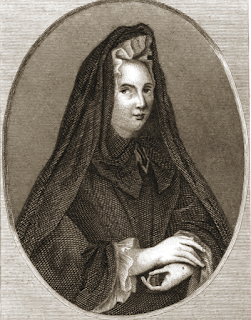
The life of those who dwell in the secret place of the Most High may be called a Hidden Life, because the animating principle, the vital or operative element, is not so much in itself as in another. It is a life grafted into another life. It is the life of the soul, incorporated into the life of Christ; and in such a way, that, while it has a distinct vitality, it has so very much in the sense, in which the branch of a tree may be said to have a distinct vitality from the root.
Showing posts with label The Life of Madam Guyon. Show all posts

Wednesday, October 22, 2025

On Acting With a Single Eye to God's Glory

Reflections on
the Life of
Madame Jeanne de la Mothe Guyon.


Her second visit to the city of Orleans. Interview and conversation with a' Jesuit. Remarks upon it. Comments on undue spiritual earnestness or spiritual impetuosity.


I will here mention an incident of a religious nature, which seems to be worth noticing. In the latter part of the year 1763, she visited the city of Orleans a second time, for the purpose of being present at the marriage of her brother. While there, she became acquainted with an individual of the society of the Jesuits, who exhibited some interest in hearing the details of her religious experience. She corresponded to this desire, with much vivacity and very fully. The effort to relate her feelings reacted upon herself, and gave a high degree of sensible satisfaction, in distinction from that satisfaction which results solely from the discharge of duty, — so that she was led to speak of her views and feelings at much length. This conversation, which to most persons, would have appeared commendable rather than otherwise, caused her considerable regret afterwards. She began to see, that, in the progress of religion, it is not only necessary to do the right thing, but to do it  in the right spirit. The source of her sorrow was, that she found on reflection that she had spoken from the life of nature, not excluding a degree of self-gratulation, which she probably did not perceive at the time, — and not wholly from a single eye to God's glory.

Wednesday, May 7, 2025

The Death of Genevieve Granger


Reflections on
the Life of
Madame Jeanne de la Mothe Guyon.


Birth of a son. Her religious state at this period,  1673.  Death of Genevieve Granger. Their intimacy with each other. Remarks on this addiction. General remarks on worldly attachments and supports.


One of the incidents of the year 1673, to which these series of events now bring us, was the birth of her fourth child, a son, whom Providence had given her in the place of the too much idolized boy, whom she had lost two years before. This son, who seems to have proved himself worthy of her affections, grew up to manhood. But, the grace of God enabled her to love him with that pure and chastened affection which holds every thing in subordination to the divine will. 

Tuesday, December 10, 2024

The Death of Her Father and Her Daughter

Reflections on
the Life of
Madame Jeanne de la Mothe Guyon.


Incidents of 1672. Presentiment of her father’s death. A message reaches her soon after with the news of his last sickness. His death. Remarks. Affectionate eulogium on her daughter.  Her sickness and death.


Thus passed the year 1671. I am particular in the periods of time, so far as I am able to ascertain them, which is not always easy to be done. And the reason is, that by connecting the dealings of God and the progress of the inward life with specific times and situations, the mental operation is aided, and we can hardly fail to have a clearer idea of the incidents which are narrated. Another year had now opened upon her, and found her renewedly consecrated to God, and growing wiser and holier through the discipline of bitter experience. Her trials had been somewhat less in this year than in the preceding, but still they were not wholly suspended. And as God designed that she should be wholly his, there were other trials in prospect, which were designed to aid in this important result. We proceed, therefore, in our narrative, with such incidents and facts as we are able to gather from the sources of information found in her own writings and in the writings of some of her contemporaries, which remain to us.

Wednesday, November 20, 2024

A Conqueror, But Not at Rest

Reflections on
the Life of
Madame Jeanne de la Mothe Guyon.


Her growth  in  grace. The account she gives of her will, as subdued in its operations, but not wholly renovated in its nature. Remarks on this subject.


 Whatever mistakes she may have committed in the period of which we are now speaking, it is evident that she was growing in grace. The world had lost, in an increased degree, its power. Her inward nature had become more conformed to the requisitions of the gospel law. We have evidence of this in various ways. Among other things, speaking of Paris,  which had formerly been to her a place of temptation and injury, she remarks, in connection with a visit which she was obliged to make there, 

Tuesday, November 19, 2024

Francis de la Combe

Reflections on
the Life of
Madame Jeanne de la Mothe Guyon.


Her first acquaintance, July  1671, with Francis La Combe. Some account of him.


It  is during this period of her personal history, as it is given in her Autobiography, that we first find mention made of Francis de la Combe. As this somewhat distinguished individual is closely connected with a portion of her history, it may be proper to say something of him. He was born at Thonon, a flourishing town of Savoy, situated on the borders of the lake of Geneva. 

Monday, November 18, 2024

Christian Experience and Present Duty

Reflections on
the Life of
Madame Jeanne de la Mothe Guyon.


Discharge of domestic and other duties. Trials in relation to her seasons of prayer. Of the faults of which she considered herself guilty at this period. Remarks on a regard for God's providences.


She thought, therefore, with some reason, that at this period of her life she might have failed, in some degree, in her duty to her husband and her family, in consequence of not fully understanding the will of God as developed in his providences. And this view of things perhaps gives a significancy to a remark, which her husband once made, that "she loved God so much that she had no love left for him." It will help to illustrate the source of error and trouble which we are now trying to explain, if we give one or two other facts, which involve the same principle. She had a beautiful garden. And in the time of fruits and flowers, she often walked there. But such was the intensity of her contemplations on God, such "her inward attraction," as she expresses it, that her eye seemed to be closed, and she knew nothing, comparatively speaking, of the outward beauty which surrounded her. And when she went into the house, and her husband asked her how the fruits were, and how the flowers grew, she knew but little about it. And it was not surprising, I think, that it gave him considerable offense.

Saturday, November 16, 2024

Prayer — But, Without God's Favor

Reflections on
the Life of
Madame Jeanne de la Mothe Guyon.


Discharge of domestic and other duties. Trials in relation to her seasons of prayer. Of the faults of which she considered herself guilty at this period. Remarks on a regard for God's providences.


 Undoubtedly, in an important sense of the terms, the religious man's place is his closet. "Enter into thy closet" says the Saviour, "and pray to thy Father, who seeth in secret." The closet is an indispensable place to him. But whenever he goes there in violation of God's providence. it ceases to be a place of God's appointment, and he goes  there without God, It should never be forgotten, therefore, that it is God himself, who consecrates the place, and makes it a profitable one. And He will never consent to be jostled out of his true locality, which is always ascertained and designated by His providences, by means of any merely human arrangements. And accordingly we may lay it down as an important practical principle, that the times and places which are erected within the sphere of God's providences, and are in harmony with them, are right and well; and that all other times and places are wrong.

Friday, November 15, 2024

Particular Times and Places

Reflections on
the Life of
Madame Jeanne de la Mothe Guyon.


General remarks on her experience during the year 1671. (1)


 During the year 1671, the hand of the Lord, considered in comparison with its former dealings, seems to have been staid. God had found her faithful; and her soul without having entered into the state of permanent rest and union, experienced, amid all her trials, a high degree of inward consolation and peace. She was patient and faithful in the discharge of domestic duties, regular and watchful in her seasons of private devotion, and prompt in performing the duties of kindness and benevolence to others. In intimating that her trials were diminished, as compared with those of the preceding year, we do not mean to say that she was without trials; but, whatever they were, she was greatly supported under them. And I think it may be added, that, both by the griefs she suffered, and by the duties she discharged, and by the supports and consolations which were afforded her, the process of inward crucifixion was continually going on.

Wednesday, November 13, 2024

Faithfulness in Trial

Reflections on
the Life of
Madame Jeanne de la Mothe Guyon.


Faithfulness in trial. Spiritual consolations.


In all the trials which she was thus called to endure, in the afflictions of her own person, and in the loss of her favorite son, it may be said of her, as it was of Job, — who is naturally called to mind by the story of her sufferings, — that she "sinned not, nor charged God foolishly."  So far, at least, as the occurrences, which have now been mentioned, are concerned, the sincerity of the consecration which she had made of herself and of all her interests to God, had been tried; and through the grace of God it had not been found wanting.

Friday, April 5, 2024

Poetry: Divine Justice Amiable

Reflections on
the Life of
Madame Jeanne de la Mothe Guyon.


Her poetical writings. Justice of God amiable.


It is about this time that we find the first mention of her attempts at poetry. Poetry is the natural expression of strong feeling. She felt, and she wrote. It is possible that she had made attempts of this kind before; but I find nothing said of it. Voltaire, who goes out of his appropriate sphere of judgment in discrediting her religious pretensions, speaks lightly also of her effusions in verse. It would require a more intimate knowledge of French poetical diction than I profess to have, to give an opinion of her poetry, so far as the expression is concerned. But I do not hesitate to say, with great confidence, that this portion of her writings, with some variations; undoubtedly, exhibits in a high degree the spirit of poetry. There is thought in it; there is feeling. The highest kind of thought, the deepest feeling. The following poem, translated by Mr. Cowper, whom some critics, I think, would not place below Voltaire, either as a writer or judge of poetry, may be regarded as expressive, in some particulars, of her religious experience at this time ; and is probably to be referred, in its origin, to this period of her life. It indicates a deep sense of her unworthiness, and a humble and approving resignation to God's will, under the heaviest inflictions of His providence.

Thursday, April 4, 2024

Smallpox & Sorrow

Reflections on
the Life of
Madame Jeanne de la Mothe Guyon.


Attacked by the smallpox. Treatment experienced from her stepmother. Death of her youngest son. Her feelings.


The first thing [God] did was to smite her beauty with that dreadful scourge of the human race, the small-pox. The summer was over; her ear no longer listened to the waters of the Loire; the festivities of St Cloud and Paris had passed away. On the 4th of October, 1670, (she is particular to mark the month and the day,) the blow came upon her like lightning from heaven. This dreadful disease was not then shorn of its terrors by that merciful Providence, which directed the philosophic mind of Jenner in the discovery of its wonderful preventive. And she was thus smitten when she was a little-more than twenty-two years of age, — a period of life when beauty of person does not cease to be prized. When it was discovered that the hand of the Lord was thus upon her, her friends, not excluding those in all probability who had endeavored to lead her into the follies of fashionable life, exhibited great emotion. They came around her bedside, and almost forgetting that her life was in danger, deplored in feeling language the mysterious and fatal attack, which was thus made upon charms which had been so much celebrated.

Wednesday, April 3, 2024

Full Consecration: The Second Death

Reflections on
the Life of
Madame Jeanne de la Mothe Guyon.


Renewed consecration, in which she gives up all without reserve.


And here, I think, we may mark a distinct and very important crisis in the history of her spiritual being. Taught by sad experience, she saw the utter impossibility of combining the love of the world with the love of God. "From this day, this hour, if it be possible, I will be wholly the Lord's. The world shall have no portion in me." Such was the language of her heart ; such her solemn determination. She formed her resolution after counting the cost, — a resolution wbich was made in God's strength and not in her own; which, in after life, was often smitten by the storm and tried in the fire; but, from this time onward, so far as we know anything of her history, was never consumed, — was never broken. She gave herself to the Lord, Not only to be his in the ordinary and mitigated sense of the terms, but to be his wholly, and to be his forever; to be his in body and in spirit; to be his in personal efforts and influence; to be his in all that she was and in all that it was possible for her to be. There was no reserve.

Monday, April 1, 2024

Advice from a Stranger

Reflections on
the Life of
Madame Jeanne de la Mothe Guyon.


[She attends] religious services at the church of Notre Dame in Paris. On her way thither she has an extraordinary interview with a person unknown. His advice to her.


It was at this period of her personal history, that [Madame Guyon] began to have a more distinct and realizing perception of what is implied in a sanctified life. Some portions of her reading, as well as her personal experience, had been favorable to this result. In the Life of Madame de Chantal, which she had read with great interest, she found the doctrine of holiness, so far as it may be supposed to consist in a will subjected to God, and in a heart filled with love, illustrated in daily living and practice, as well as asserted as a doctrine. The writings of Francis de Sales are characterized, in distinction from many other devout writings of the period in which he lived, by insisting on continual walking with God, on the entire surrender of the human will to the divine, and on the existence of pure love. The writings of this devout and learned man seem to have been her constant companions through life. The Imitation of Christy generally ascribed to Thomas a Kempis, Another of the works with which she was familiar, is animated by the same spirit of high Christian attainment. All these writers, in different ways and under different forms of expression, agree in strenuously teaching, that the whole heart, the whole life should be given to God; and that in some true sense this entire surrender, not excluding, however, a constant sense of demerit and of dependence on God, and the constant need of the application of Christ's blood, is in reality not less practicable than it is obligatory. 

Saturday, March 30, 2024

Madame Guyon Seeks Spiritual Advice

Reflections on
the Life of
Madame Jeanne de la Mothe Guyon.


Reference to her early views of her Christian state. Her surprise at the discovery of the remains of sin in herself. Seeks assistance and advice from others. Remarks on the religious character of that age. Consults with Genevieve Granger, the Prioress of the Benedictines.


In this season of temptation and penitence, of trial and of comparative despondency, she looked around for advice and assistance. Not fully informed, as she herself expressly states, in respect to the nature of the inward life, she felt perplexed and confounded at the knowledge of her own situation. In the first joy of her spiritual espousals, she seems to have looked upon herself, as is frequently the case at that period of religious experience, not only as a sinner forgiven for the sins which are past; but what is a very different thing, as a sinner saved from the commission of sin for the present, and in all future time. Looking at the subject in the excited state of her young love, when the turbulent emotions perplex the calm exercises of the judgment, she appears to have regarded the victory which God had given her, as one which would stand against all possible assaults; the greatness of her triumph for to-day, scarcely exceeding the strength of her confidence for to-moirow. She felt no sting in her conscience; she bore no cloud on her brow.  

Saturday, March 2, 2024

Remarks on Holy Living

Reflections on
the Life of
Madame Jeanne de la Mothe Guyon.


Inquiries on holy living


There is but one way for the Christian to walk in. It is not possible that there should be any other. "A strait and narrow way" it is true; but still, properly speaking, not a difficult way. Undoubtedly it is difficult to a heart naturally averse to it, to enter into it, and to become entirely naturalized to it. Sometimes the difficulty is very great; but when once the process is fairly begun, and the influence of old habits is broken, the difficulty is, in a great degree, removed; and it becomes true, as the Saviour has said, that His "yoke is easy, and His burden is light." 

Friday, March 1, 2024

A Visit to St. Cloud

Reflections on
the Life of
Madame Jeanne de la Mothe Guyon.


Visit to St. Cloud — Sorrow


If, under the impulse of an unsanctified curiosity, she gave an unguarded look, — if in a moment of temptation she uttered a hasty reply to the rebukes and accusations of others, (moral delinquencies which some might not regard as very great,) — she found that it cost her bitter tears. Even when she dispensed her munificent charity; which brought consolation to the poor and suffering, she sometimes found, with sorrow of heart, that the donation which ought to have been made with "a single  eye," was corrupted by a glance at the rewards of self-complacency and of worldly applause.

Monday, February 26, 2024

Wholly Devoted to God: Mortifications

Reflections on
the Life of
Madame Jeanne de la Mothe Guyon.


We are to consult our own improvement and good, as well as of others — Desires to be wholly the Lord’s — Efforts to keep the outward appetites in subjection


“Thou shalt love thy neighbour as thyself.” Our own vineyard is not to be neglected. True Christianity verifies its existence and its character, not merely in doing good to others, but partly, at least, in the regulation of our own inward nature. It is not enough to visit the sick and teach the ignorant, to feed the hungry and clothe the naked, while we leave our own appetites and passions unsubdued, unregulated.