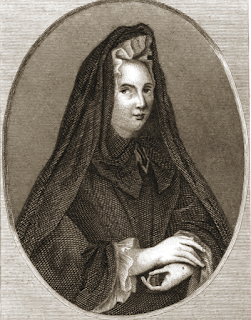
The life of those who dwell in the secret place of the Most High may be called a Hidden Life, because the animating principle, the vital or operative element, is not so much in itself as in another. It is a life grafted into another life. It is the life of the soul, incorporated into the life of Christ; and in such a way, that, while it has a distinct vitality, it has so very much in the sense, in which the branch of a tree may be said to have a distinct vitality from the root.
Showing posts with label recollection. Show all posts

Wednesday, October 22, 2025

On Acting With a Single Eye to God's Glory

Reflections on
the Life of
Madame Jeanne de la Mothe Guyon.


Her second visit to the city of Orleans. Interview and conversation with a' Jesuit. Remarks upon it. Comments on undue spiritual earnestness or spiritual impetuosity.


I will here mention an incident of a religious nature, which seems to be worth noticing. In the latter part of the year 1763, she visited the city of Orleans a second time, for the purpose of being present at the marriage of her brother. While there, she became acquainted with an individual of the society of the Jesuits, who exhibited some interest in hearing the details of her religious experience. She corresponded to this desire, with much vivacity and very fully. The effort to relate her feelings reacted upon herself, and gave a high degree of sensible satisfaction, in distinction from that satisfaction which results solely from the discharge of duty, — so that she was led to speak of her views and feelings at much length. This conversation, which to most persons, would have appeared commendable rather than otherwise, caused her considerable regret afterwards. She began to see, that, in the progress of religion, it is not only necessary to do the right thing, but to do it  in the right spirit. The source of her sorrow was, that she found on reflection that she had spoken from the life of nature, not excluding a degree of self-gratulation, which she probably did not perceive at the time, — and not wholly from a single eye to God's glory.

Friday, November 3, 2017

Guard Against the Habits of Unbelief

Those, who are in assurance of faith, or who are aiming at and approximating that state, should guard against the influence of former habits of unbelief. The fact, that they have given themselves wholly to God, and that he has promised to accept them, and that he does now accept them, while it furnishes ample basis of the assured belief of their acceptance with God, is not inconsistent with strong temptations to unbelief. Against the influence of these temptations they would do well carefully to guard. They should resist them, not only by prayers to God, but by fixed resolutions, by strong purposes; remembering that the doubts, which are thus suggested, and which they are thus called upon to resist, do not spring from real evidence adverse to their acceptance with God, but chiefly from the influence of a species of infirmity and vacillation of mind resulting from former habits of unbelief.

Tuesday, April 4, 2017

The Stroke of a Dart

Reflections on
the Life of
Madame Jeanne de la Mothe Guyon.


It  may be interesting to hear Madame Guyon state the effect of this conversation in her own words.

Having said these words, the Franciscan left me. They were to me like the stroke of a dart, which pierced my heart asunder.  I  felt at this instant deeply wounded with the love of God; — a wound so delightful, that I desired it never might be healed. These words brought into my heart what I  had been seeking so many years; or rather they made me discover what was there, and which I did not enjoy for want of knowing it. Oh my Lord! thou wast in my heart, and demanded only the turning of my mind inward, to make me feel thy presence. Oh, infinite Goodness! Thou wast so near, and I ran hither and thither seeking thee, and yet found thee not. My life was a burden to me, and my happiness was within myself. I was poor in the midst of riches, and ready to perish with hunger near a table plentifully spread and a continual feast. Oh Beauty; ancient and new! Why have I known thee so late? Alas, I sought thee where thou wast not, and did not seek thee where thou wast! It was for want of understanding these words of thy Gospel: 'The kingdom of God cometh not with observation, neither shall they say, Lo! here, or  lo!  there; for, behold, the kingdom of  God is within you.' This I now experienced, since thou didst become my King, and my heart thy kingdom, where thou dost reign a Sovereign, and dost all thy will.

I told this good man, that I did not know what he had done to me; that my heart was quite changed; that God was there; for from that moment he had given me an experience of his presence in my soul, — not merely as an object intellectually perceived by any application of mind, but as a thing really possessed after the sweetest manner. I experienced those words in the Canticles:  'Thy name is as precious ointment poured forth; therefore do the virgins love thee.' For  I felt in my soul an unction, which, as a salutary perfume, healed in a moment all my wounds. I slept not all that night, because thy love, oh my God! flowed in me like delicious oil, and burned as a fire which was going to destroy all that was left of self in an instant. I was all on a sudden so altered, that I was hardly to be known either by myself or others. I found no more those troublesome faults, or that reluctance to duty, which formerly characterized me. They all disappeared, as being consumed like chaff in a great fire.

I now became desirous that the instrument hereof might become my Director,  in preference to any other. This good father, however, could not readily resolve to charge himself with my conduct, though he saw so surprising a change effected by the hand of God. Several reasons induced him to excuse himself: first, my person, then my youth, for I was only twenty years of age; and lastly, a promise he had made to God, from a distrust of himself, never to take upon himself the direction of any of our sex, unless God, by some particular providence, should charge him therewith. Upon my earnest and repeated request to him to become my Director, he said he would pray to God thereupon, and bade me do so too. As he was at prayer, it was said to him, 'Fear not that charge; she is my spouse.' This, when I heard it, affected me greatly. 'What! (said I to myself,) a frightful monster of iniquity, who have done so much to offend my God, in abusing his favors, and requiting them with ingratitude, — and now, thus to be declared his spouse!’ After this he consented to my request.

Nothing was more easy to me now than to practice prayer. Hours passed away like moments, while I could hardly do anything else but pray. The fervency of my love allowed me no intermission. It was a prayer of re­joicing and of possession, wherein the taste of God was so great, so pure, unblended and uninterrupted, that it drew and absorbed the powers of the soul into a profound recollection, a state of confiding and affectionate rest in God, existing without intellectual effort. For I had now no sight but of Jesus Christ alone. All else was excluded, in order to love with greater purity and energy, without any motives or reasons for loving which were of a selfish nature.

— edited from The Life of Madam Guyon Volume 1, Chapter 6.

Saturday, April 1, 2017

The Influence of M. De Toissi

Reflections on
the Life of
Madame Jeanne de la Mothe Guyon.


Another individual, besides the lady whose conversation and influence have just now been stated, had a share in that series of providences, which God saw to be necessary, in order to turn the mind of Madame Guyon from the world to himself. This was a pious person, who has already been mentioned, M. De Toissi, the nephew of M. De La Mothe. He had been to Cochin China as a sharer in the religious enterprises which were carried on there, and after an absence of about four years, had returned on business connected with the Mission with which he was associated. 

He visited the house of M. De La Mothe, where his cousin, Madame Guyon, was exceedingly glad to see him. She knew his character. She remembered what was said of his conversation and his appearance, when he visited her father's house some years before, just  before his departure for the East. And, in her present state of mind, groping about as she was in solitude and desolation of spirit, she eagerly sought interviews and conversations with pious persons. This pious cousin, impelled by natural affection as well as by a regard for the interests of religion, did all that he could to encourage her in her search after God. There were other things which gave him an increased interest in the case, such as her personal accomplishments, her great talents, the wealth of her family, her position in society, and her comparative youth, — circumstances, which, in that age of worldly splendor and enjoyment, were particularly adverse to the humble and pure spirit of religion. And it was not easy for one to see the possessor of them seeking religion, with a full determination to be satisfied with nothing else, without feeling a deep interest in the result, — much more so, probably, than would be felt in ordinary cases. Madame Guyon very freely and ingenuously stated her views of her inward state to her cousin, — the faults of her character, her inward sense of her alienation from God, the efforts she had made, and the discouragements she had met with. He expressed the deepest interest in her case. He prayed for her. He gave such advice as he was able. With earnest exhortations he cheered her onward, not doubting that God's wisdom and goodness would bring all well in the end.

Her interviews with this good man had an encouraging effect. His spiritual habits, as well as his conversation, affected her. Among other things she gives us to understand, that he was in a state of inward and continual communion with God; that state of mind, probably, which, in accordance with the nomenclature of the higher experimental writers, she variously denominates, in her religious works, as the state of "Recollection," or of "Recollection in God;" and which I think may be properly denominated the Prayer of Recollection. This state of continual prayer affected her much, although she was unable at that time, as she expressly admits, to understand its nature. She also noticed, with interest and profit, the conversation which passed between him and the exiled lady resident at her father's, who has already been mentioned. As is the case with all truly religious people, they seemed to understand each others' hearts. "They conversed together," she says, "in a spiritual language.”  They had that to speak of, which souls unconverted can never know,— a Savior "who was no longer as a root sprung out of the dry ground," sins forgiven, and joy and peace in believing. 

The example and the exhortations of her cousin, De Toissi,  could not fail to make a deep impression. Many were the tears she shed when he departed. She renewed her solemn resolutions. She endeavored to imitate him in his state of continual prayer, by offering up to God ejaculations, either silent or spoken, moment by moment. On the system of making resolutions and of mere human effort, she seems to have done all that she could do. But still she did not understand; a cloud hung over one of the brightest intellects when left to itself, — so perplexing to human wisdom, and so adverse to the natural heart is the way of forgiveness and justification by faith alone. Those know it who experience it, and those only; but her hour had not yet come. 

More than a year had passed in this state of mind, and with such efforts, —  but apparently in vain. With all these appliances which have been mentioned, with afflictions on the one hand to separate her from earthly objects, and encouragements on the other to allure her to heaven, she still seems to have remained without God and without hope in the world. So much does it cost, in a fallen world like this, to detach a soul from its bondage and to bring it to God! God has not only spread the feast, in the salvation which he has offered through his Son, but, by means of ministers, both providential and personal, he goes out into the highways, and compels them to come in. 

— edited from The Life of Madam Guyon Volume 1, Chapter 6.