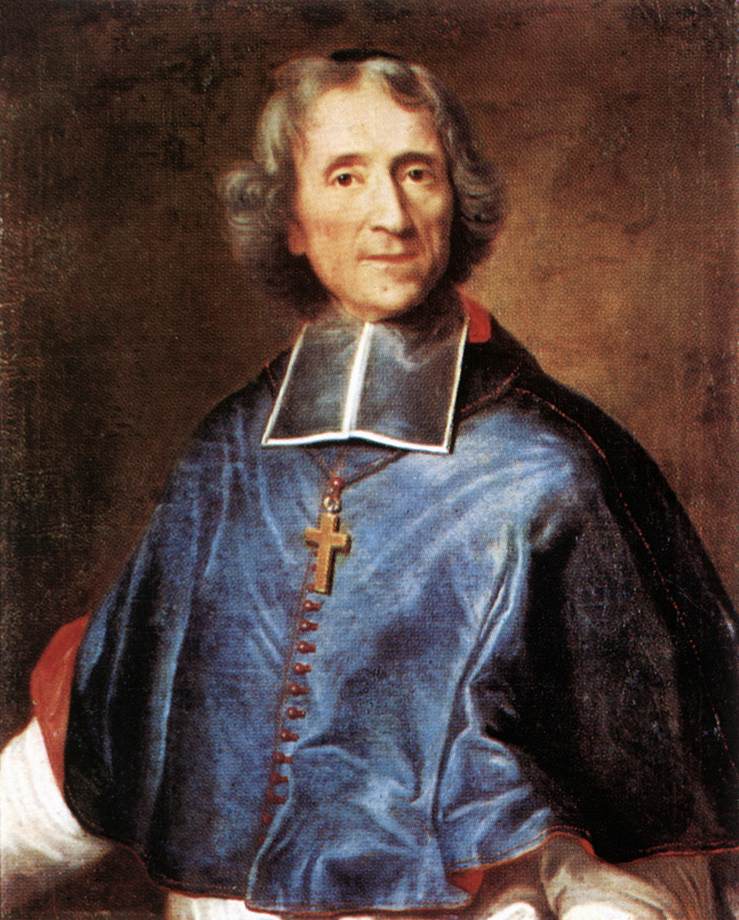
The life of those who dwell in the secret place of the Most High may be called a Hidden Life, because the animating principle, the vital or operative element, is not so much in itself as in another. It is a life grafted into another life. It is the life of the soul, incorporated into the life of Christ; and in such a way, that, while it has a distinct vitality, it has so very much in the sense, in which the branch of a tree may be said to have a distinct vitality from the root.
Showing posts with label Fenelon. Show all posts

Tuesday, November 5, 2024

Crucified to Holiness Itself

But perhaps the most decisive mark of the truly crucified man is, that he is crucified even to holiness itself. That is to say, he desires God only, seeks God only, is satisfied and can be satisfied with God only, in distinction from those truly spiritual gifts or graces, which God by his Holy Spirit imparts to the soul.

The truly devout man, for instance, exercises penitence, submission, gratitude, forgiveness, and other Christian graces on their appropriate occasions; and he has great reason to be thankful to God that he is enabled to do it. But if in some moment of inward forgetfulness, of religious “irrecollection,” if we may so term it, he turns the thoughts and the interests of his heart from God to the graces which God gives, and begins to take complacency in his religious exercises, and to be happy in his holiness and to love his holiness, instead of a fixed and exclusive love for the Author of his holiness, I think we may confidently say, he is no longer a man dead to self, no longer in the proper sense of the terms a man inwardly crucified. 

“The purer our gifts are,” says Fenelon, “the more jealous God is of our appropriating or directing them to ourselves. The most eminent graces are the most deadly poisons, if we rest in them and regard them with complacency. It is the sin of the fallen angels. They only turned to themselves, and regarded their state with complacency. At that instant they fell from heaven, and became the enemies of God.”

— from The Life of Faith, Part 2, Chapter 12.


Tuesday, January 17, 2017

Aids to the Biography of Madame Guyon

Reflections on
the Life of
Madame Jeanne de la Mothe Guyon.


Not unfrequently [Madam Guyon] is introduced in the following work, as speaking of herself in the first person; sometimes detailing the outward incidents of her life, and sometimes giving an account of her opinions and inward experience. It  is proper to say here, that, in translating passages where she speaks of herself and her opinions, I have aimed rather to give the sentiment, than the precise mode of expression. In some cases, in order to complete the statement and make it consistent with itself, I have combined what is said in one place with what is said in another. It is sometimes the case, also, that in the original, something, instead of being brought out prominently to notice, is merely involved in what is said, or is indistinctly but yet really intimated, which it has been necessary, in order to give a clear idea of the subject, to develop in distinct propositions, and to make a part of the statement, whatever it may be. So that, sometimes, instead of a mere rendering of word for word, or a mere translation in the ordinary sense of the terms, I give what may be termed perhaps an  interpreted  translation; that is to say, a translation of the spirit rather than of the letter. This course seemed to me a proper one, not only for the reader, but in order to do full justice to Madame Guyon herself. I may add here, that I have availed myself, from time to time, of the aid offered by the judicious translation which Mr. Brooke has made of a portion of her Life, and of the work entitled "A Short Method of Prayer."

The Second Volume of the work is occupied, in a considerable degree, with the acquaintance which was formed in the latter part of her life between Madame Guyon and Fenelon, Archbishop of Cambray; with the influence which was exerted by her over that truly distinguished man; with the religious opinions which were formed and promulgated under that influence, and with the painful results which he experienced in consequence. These details, I think, will be found to communicate important instruction, while they will not fail in interest. The discussions, in this part of the work, turn chiefly upon the doctrine of pure or unselfish love, in the experience of which Fenelon thought, in accordance with the views of Madame Guyon, and it seems to me with a good deal of reason, that the sanctification of the heart essentially consists. It is true, that they insist strongly upon the subjection of the will; but they maintain, as they very well may maintain, that such a love will certainly carry the will with it.

The work is committed to the reader, not without a sense of its imperfections, but still in the hopes that something has been done to illustrate character, and to confirm the truth.

[TO BE CONTINUED]

— from The Life of Madam Guyon (1877) Volume 1 "Preface."

Saturday, July 16, 2016

Inward Recollection Inhibits the Self

Another favorable result, connected with the habit of inward recollection, is, that, by confining the mind to the present moment, and retaining God in the position of a present counselor and guide, it prevents the exercise of reflex and selfish acts on the past, and also undue and selfish calculations for the future. Self, if we permit it, will either secretly or openly find nourishment every where; and every where, therefore, we are to fight against it, overcome it, slay it. When the past is gone and we are conscious that we have done  our duty in it, if we would not have the life of self imbibing strength from that source, we must leave it with God in simplicity of spirit; and not suffer it to furnish food either for vanity or disheartening regrets. We should avoid also all undue and selfish calculations for the future, such as continually agitate.and distract the minds of the people of the world; and indeed all thoughts and anticipations of a prospective character, which do not flow out of the facts and the
relations of the present moment, and which are not sanctioned by a present divine inspection.

Happy is the man who retains nothing in his mind, but what is necessary; and who only thinks of each thing just when it is the time to think of it; so that it is rather God, who excites the perception and idea of it, by an impression and discovery of his will which we must perform, than the mind's being at the trouble to forecast and find it. — Fenelon's Directions for a Holy Life.

To these important results, there can be no question, that the habit of inward recollection is exceedingly favorable.

— edited from The Interior or Hidden Life  (2nd Edition, 1844) Part 3, Chapter 7.

Saturday, April 30, 2016

The Present Moment Has a Moral Extension

\Impressions and impulses, which are not from the Holy Spirit, but from some other source, such as a disordered imagination, the world or the devil, are not of that peaceful and quiet character which has been mentioned; but are hasty and violent. In violation of the great Scriptural maxim, "HE THAT BELIEVETH SHALL NOT MAKE HASTE" the person, who is under this pernicious influence, thinks he cannot be too quick. He makes but little account of obstacles; he cannot take time for interior examination; he has no open eye to God's outward providences; he is too impetuous, too much possessed by himself or by Satanic influence, to engage in calm and humble prayer for guidance; in a word, he rushes blindly onward just as his great adversary, who is especially interested in his movements, would have him.


The great plea of these persons is, that the time is Now; that what is to be done is to be done Now; that the present moment is the true moment of action. This is essentially true; but there is a valuable remark of FĂ©nelon, which places the doctrine of present or immediate action in its correct position.  It is, that THE PRESENT MOMENT HAS A MORAL EXTENSION. In other words, we are undoubtedly bound to fulfill the duty of the present moment; but it is the present moment, not in a state of barren insulation, but considered in all its relations to God, man, and the universe. But it is perfectly obvious, that the duties of the present moment cannot be fulfilled in their moral extension without calling in the aid of a calmly reflective and sanctified judgment.

 — edited from The Interior or Hidden Life (2nd edition 1844) Part 3, Chapter 4.

Thursday, September 17, 2015

We Must Sacrifice Even the Gifts of God

All the Christian gifts and graces should be possessed in purity of spirit, uncontaminated by any unholy mixtures of an earthly nature. The mere suggestion, that they have merit of themselves and separate from the God who gives them, if it be received with the least complacency, necessarily inflicts a deep wound. They are, accordingly, held in purity of spirit and with the divine approbation, only when their tendency is to separate the soul from every thing inward and outward, considered as objects of complacency and of spiritual rest, and to unite it more and more closely to God.

In the language of Fenelon, "we must sacrifice even the gifts of God;" that is to say, we must cease to regard them and to take complacency in them, in themselves considered, that we may have God himself. We do not find the parent, who has that degree of affection for his child, which may be called entire or perfect love, making his love a distinct object of his thoughts, and rejoicing in it, as such a distinct object; that would not be the genuine operation of perfect love. If his love is perfect, he has no time and no disposition to think of any thing but the beloved object, towards which his affections are directed. His love is so deep, so pure, so fixed and centered upon one point, that the sight of self and of his own personal exercises, is lost.  It ought to be thus in the feelings, which we exercise towards God; and undoubtedly such will be the result, when the religious feeling has reached a certain degree of intensity. That is to say, when the feeling is perfect, the mind is not occupied with the feeling itself, but with the object of the feeling. The heart, if we may so express it, seems to recede from us; it certainly does so as an object of distinct contemplation; and the object of its affections comes in and takes its place. Oh the blessedness of the heart, that, free from self and its secret and pernicious influences, sees nothing but God; that recognizes, even in its highest gifts and graces, nothing but God; that would rather be infinitely miserable with God, if it were possible, than infinitely happy without him.

Wednesday, September 16, 2015

How Selfishness Corrupts Even the Gifts of God

It is difficult to express and even to conceive of the subtleties and insinuations of selfishness.  It enters every path. It lurks in every secret place. And wherever it finds its way, it pollutes, poisons, and destroys. It sometimes attaches itself, by a process almost imperceptible, to God's most valuable gifts and graces; those which are spiritual, as well as those which are natural. An individual, for instance, is possessed of great natural ability. This ability is a gift of God. But how often it is, that the possessor, thinking but little of the great Author of the gift, regards it as something peculiarly his own, and instead of seeing God in it, sees only himself. Almost unconsciously to himself, and greatly to his spiritual injury, he is experiencing a secret elevation of spirit, and is taking a hidden complacency in an intellectual possession, which, when properly considered, should have increasingly detached him from self, and led him nearer to his Maker.

Wednesday, June 3, 2015

Curiosity Can Work Against Faith

A life, of which excessive curiosity is the leading element, is necessarily antagonistical to a life of faith. Knowledge necessarily excludes faith, in regard to the thing which is known. And we do not hesitate to say, that ignorance with faith is, in many things, better than knowledge without it. In many things, therefore, having relation to ourselves and others, and especially in many things, which have relation to the divine government, we must be willing to remain in the darkness of sense, in order that we may enjoy the light of religious trust. It is obvious, that this is a condition, to which the man of excessive curiosity does not easily submit. He is restless in his state of ignorance, because he has but little trust in God. How different is the state of mind, (a state of mind which many Christians can testify to be of inexpressible value,) which is disclosed in the devout words of Fenelon. "Behold my wants which I am ignorant of; but do Thou behold, and do according to thy mercy. Smite or heal! Depress or raise me up! I adore all thy purposes without knowing them."

The Interior or Hidden Life (1844) Part 2, Chapter 7.

Thursday, May 7, 2015

Solitary Communion with God as a Means to Regulalting the Social Instinct

The social principle, like others, may become inordinate in its action. In the natural life, in distinction from the regenerated or sanctified life, every thing runs to excess, in consequence of the prevalence of selfishness and the absence of the love of God. And thus the social principle, implanted originally for a good end, may become, as in point of fact it often does become, more or less excessive and vicious in its operation. In what way then, shall the discharge of the duty of social intercourse be regulated, so that the divine blessing may rest upon it? In reply to this question it may be admitted, that it is neither easy nor safe to lay down specific rules applicable in all cases. It is obvious that what would be right and proper under some circumstances, would be inexcusable under others. It is perhaps best, therefore, that the conduct of each individual should be left to be regulated by the decisions of a sound and consecrated discretion, made in view of the circumstances of each occasion as it arises.

In all ordinary cases, however, it may be safely said, that some portion of each day, and especially a portion at the commencement of the day, should be devoted to solitary communion with God. The soul needs the resources and refreshment of such seasons of sacred retirement, in order to put itself into a situation to meet those trials of its faith and patience, which are incidental even to social intercourse.— Nor is this all. We should also have seasons of special religious recollection, while we are acting in and with society, in which we may turn our thoughts inward and upward; to the state of our own hearts on the one hand, and to God as the true source of wisdom and support on the other. Many pious persons have found this practice very important to them. It is said of FĂ©nelon, in connection with the numerous claims of society upon him, claims which he promptly met with admirable condescension and wisdom, that he nourished the inward divine life, even in the midst of such multiplied interruptions, by praying "in the deep retirement of internal solitude."

— from The Interior or Hidden Life (1844) Part 2, Chapter 6.

Monday, September 8, 2014

Self Love Is Subordinate to Love for God

We love ourselves, only as we love God. In other words, if we love God with perfect love, the love of ourselves will be subordinated and restricted by the controlling desire, THAT GOD MAY BE GLORIFIED IN  US. We can seek nothing, desire nothing, love nothing for ourselves, but what is subordinate to and has a tendency to God's glory. So that the love of self, whatever it may be, is merged and purified in the encircling and absorbing love of God. The love of our neighbor is properly measured, on the principles of the Scriptures, by the love of ourselves. And as we can love ourselves only in subordination to God's will and glory; so we can love our neighbor only in the same manner and the same degree. In other words both the love of ourselves and of our neighbor are only rills and drops from the mighty waters of love to God. And on the supposition, that we are filled with the love of God, the love of our neighbor flows out from the great fountain of divine love, in the various channels and in the degree which God chooses, as easily and as naturally, as a stream flows from its lake in the mountains over the meadows and valleys below. There is no need of effort. Only let God in his providence furnish the occasion; and in a moment the heart will open, and the streams will gush out. Hence the remarks, which are found in various places of the writings of Augustine, Thauler, and Fenelon to this effect, (and some eminent theologians of this country appear decidedly to favor this view,) that the love of God is capable of animating and regulating all those affections, which we owe to his creatures, that the true manner of loving our neighbor, is to love him in and for God; and that we never love him so purely and so much, as when we love him in this way.

— edited from The Interior or Hidden Life (1844) Part 1, Chapter 13.

Monday, April 21, 2014

Christian Simplicity

When on a certain occasion the pious Fenelon, after having experienced much trouble and persecution from his opposers, was advised by some one to take greater precautions against the artifices and evil designs of men, he made answer in the true spirit of a Christian, MORIAMUR IN SIMPLICITATE NOSTRA, "let us die  in our simplicity."  He, that is wholly in Christ, has a oneness and purity of purpose, altogether inconsistent with those tricks and subterfuges, which are so common among men. He walks in broad day. He goes forth in the light of conscious honesty. He is willing, that men and angels should read the very bottom of his heart. He has but one rule. His language is, in the ordinary affairs of life, as well as in the duties of religion, "My Father, what wilt thou have me to do?" — This is christian simplicity; and happy, thrice happy is he, who possesses it.

Religious Maxims (1846) XLV.